
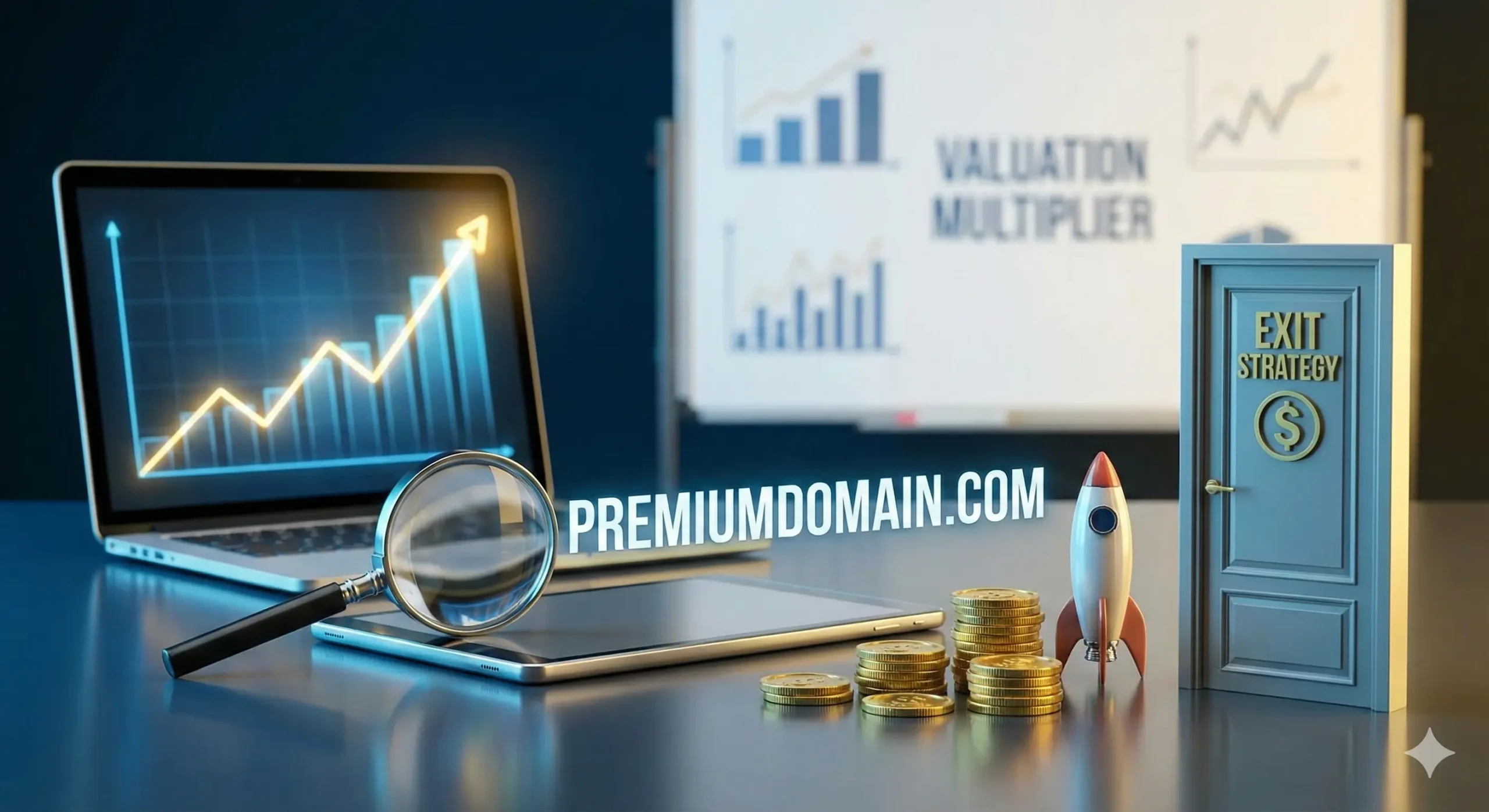
Increase Startup Valuation: Why a Premium Domain is Your Best Exit Strategy
Every founder builds with an exit in mind. Whether you are aiming for a strategic acquisition by a tech giant or a private equity buyout, your obsession is likely the same: How do I maximize the multiple on my EBITDA?
You optimize your Customer Acquisition Costs (CAC), you polish your tech stack, and you hire the best talent. Yet, when I analyze the portfolios of Series B and C companies, I see a recurring “bad decision” that leaves millions on the table:
They are building a penthouse business on rented land.
Here is why upgrading your domain is the ultimate lever for valuation growth.
Table of Contents
The “CapEx” vs. “OpEx” Mindset Shift
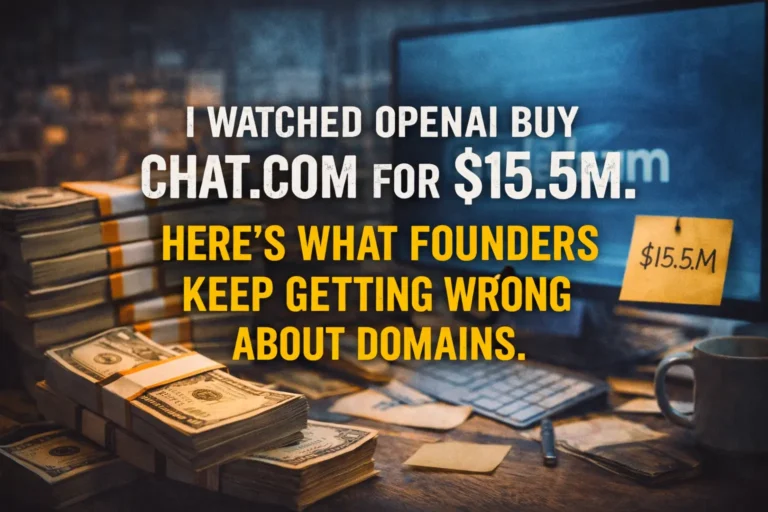
In my recent analysis of Domain Mistakes Founders Make, I discussed OpenAI’s acquisition of Chat.com. To the average observer, $15.5M seems like an exorbitant marketing expense. But to a savvy investor, that wasn’t an expense—it was an asset transfer.
When a potential acquirer looks at your startup, they classify your spending into two buckets:
• OpEx (Operating Expense): Money that is gone once spent (Ads, rent, salaries).
• CapEx (Capital Expenditure): Money converted into owned assets (IP, software, Premium Domains).
If you are operating on a “convenient” domain—something you picked up for $10 because it was available—you are signaling that your brand is a temporary expense. As I noted in Bad Decisions Founders Make, choosing convenience over quality is a psychological trap. You save $5,000 today, but you cap your exit value by millions tomorrow because you don’t own the “category king” asset.
How Domains Increase Startup Valuation Multipliers
Let’s look at the math of how domains Increase Startup Valuation. Private Equity firms and strategic acquirers pay for certainty and efficiency.
Suppose your SaaS company generates $2M in EBITDA.
• Scenario A (The “Rented” Brand): You own GetmySaas-app.io
◦ The Friction: Users mistype the email. Competitors own the .com and siphon your traffic. The acquirer sees a “rebranding risk” and creates a contingency fund.
◦ The Multiple: 6x EBITDA.
◦ Exit Price: $12M.
• Scenario B (The “Owned” Asset): You own Saas.com
◦ The Friction: Zero. You own the category. Direct traffic is free (lowering blended CAC). The brand is defensible.
◦ The Multiple: 8x EBITDA.
◦ Exit Price: $16M.
Trust Flow in the Age of AI
The SEO landscape is unforgiving. We are no longer just optimizing for Google’s 10 blue links; we are optimizing for Large Language Models (LLMs) and AI Agents.
AI models prioritize “Entity Authority.” They are designed to cite the most canonical, authoritative source for a topic.
• If you own Best-Shoes-Shop.net, an AI agent views you as a derivative entity.
• If you own Shoes.com, the AI views you as the definitive entity.
As I touched on in Brand ownership for Founders, if you don’t control the primary domain, you don’t fully control the entity. In a due diligence phase, this lack of control is a massive risk factor. Investors know that if they acquire you, they will eventually have to buy the premium domain anyway—likely at a much higher price. They will deduct that future cost from your payout today.
The “Moat” Against Competitors
Your domain is your digital “moat”. In the competitive SaaS landscape, “copycat” brands are inevitable.
If you don’t own your exact-match .com, you are essentially subsidizing your competitors. Every time a user forgets your hyphen or types .com instead of .anythingelse, they land on a competitor’s site or a domain parking page filled with ads for your rivals.
Don’t Wait for Due Diligence
By securing the asset early, you do more than just rebrand—you effectively increase startup valuation potential by removing future risk from the buyer’s equation. You turn a potential million-dollar negotiation headache into a locked-in asset on your balance sheet.
However, discretion is key. If a domain owner knows a funded startup is knocking, the price instantly skyrockets. This is where strategy meets execution.
Through BuyerAxis.com, I provide anonymous domain name acquisition services to ensure you secure the asset at fair market value. By keeping your identity shielded during negotiations, we protect your budget and ensure that your brand ownership is secured on your terms, not the seller’s.
Control Your Exit Value
You have spent years optimizing your product, your team, and your revenue model. Do not let a $10 decision regarding your domain name cap your exit potential. Getting the best domain name increase startup valuation.
As we covered in this analysis:
• Shift to CapEx: Treat premium domains as appreciating assets, not marketing expenses.
• Secure the Multiplier: Remove friction for acquirers to justify a higher valuation multiple (e.g., 8x vs 6x EBITDA).
• Build the Moat: In the AI search landscape, owning the “canonical” entity is the only defense against irrelevance.
Smart founders don’t wait for a crisis to upgrade their infrastructure. As I warned in Bad Decisions Founders Make, convenience is often a mask for future liability. The most expensive domain you will ever buy is the one you have to negotiate for during due diligence.
Take control of your digital sovereignty today.
Complimentary Risk & Valuation Assessment
Are you building equity or just renting space?
Most founders don’t realize their domain is suppressing their valuation until they sit down with an acquirer. Don’t let that happen to you.
I am offering a Complimentary Risk & Valuation Assessment for founders. I will review your current domain portfolio and analyze it against your target valuation goals.
In this audit, we will uncover:
• The Valuation Gap: How much is your current domain dragging down your multiple?
• The Traffic Leak Score: Is your current domain leaking traffic to competitors?
• The Upgrade Path: A strategic roadmap to acquire the asset that secures your legacy.
FAQ
How does a premium domain actually increase my startup’s valuation multiple?
A premium domain moves your brand from a marketing expense to a tangible asset. Acquirers pay for efficiency and market dominance. By owning the “Category King” domain you reduce Customer Acquisition Costs (CAC) through free direct traffic and eliminate rebranding risks. This “moat” allows investors to justify a higher EBITDA multiple (e.g., 8x instead of 6x) during the exit
Isn’t spending millions on a domain a waste of runway for a Series A startup?
It depends on how you classify the spend. As discussed in Domain Mistakes Founders Make, purchases like OpenAI’s $15.5M acquisition of Chat.com are Capital Expenditures (CapEx), not Operating Expenses (OpEx). This means the money isn’t “gone”—it is converted into a defensible digital asset on your balance sheet that often appreciates in value, unlike ad spend which disappears immediately.
Why shouldn’t I just wait until we are about to exit to buy the .com?
Waiting is often one of the Bad Decisions Founders Make due to convenience. If you wait until Due Diligence to acquire your core domain, the seller will likely know you are desperate or flush with cash, causing the price to skyrocket. Acquiring it early secures the asset at a lower cost and stops you from “leaking” traffic to competitors during your high-growth years
Does owning the .com really matter in the age of AI search and LLMs?
Yes. In AI landscape, search engines and AI agents prioritize “Entity Authority.” Owning the exact-match .com signals to algorithms that you are the canonical, definitive source for that topic. If you only rent a peripheral extension, AI agents may view your brand as derivative, prioritizing the .com owner as the primary entity.
What if I can’t afford the premium domain yet?
This is a common issue addressed in Brand Ownership for Founders. If you cannot buy the asset outright, you should still secure a path to control. This might involve a lease-to-own agreement or acquiring the “defensive” variations first. The goal is to ensure you eventually control your brand sovereignty rather than building equity on a platform you effectively just “rent”


The idea that a premium domain increases valuation multipliers really hits home. In today’s digital-first world, a strong, memorable domain isn’t just an asset; it’s a game changer for credibility and long-term growth.