
Brand ownership for Founders -Why most founders don’t actually control their brand
This took me a long time to see, mostly because I used to think I did control mine.
I owned the company.
I paid for the logo.
I approved the website.
I had opinions about how things should be said.
That felt like control. For many startups, this early illusion defines brand ownership for founders long before they realise what real control actually involves.
but It wasn’t.
Table of Contents
What it really was, in hindsight, was familiarity. I was close to the thing, so I mistook proximity for ownership. This confusion sits at the core of brand ownership for founders, where proximity is often mistaken for control.
You only notice the difference when something goes slightly wrong. Not a disaster. Just friction.
A sales call where you have to explain the name.
An email intro where someone spells it wrong.
A moment where a potential client says, “Oh, I thought you were something else.”
Individually, these things don’t matter. That’s why they’re dangerous. They blend into the background. You normalize them. You adapt.
Most founders are very good at adapting. Adaptation is often celebrated, but in practice it delays hard decisions around brand ownership for founders and normalizes unnecessary friction.
Too good.
We patch over small leaks instead of asking why the pipe was badly placed in the first place.
At some point I realised something uncomfortable. A lot of founders don’t really control their brand. They manage around it.
They’ve learned the workarounds so well that they stop noticing the cost.
The strange thing is, founders understand control perfectly well in other areas. Equity. Cap tables. Bank access. Product roadmap. Hiring decisions. Nobody says, “We’ll figure out ownership later” when it comes to shares.
But with brand, suddenly everything becomes temporary.
“This is fine for now.”
“We’ll upgrade later.”
“It doesn’t matter at this stage.”
That sentence “at this stage” hides a lot of damage.
Because brand decisions don’t age linearly. They compound quietly.
A name isn’t just a label. It’s an instruction. It tells people how to remember you, how to refer you, how to look for you. When that instruction is fuzzy, people don’t complain. They just half-remember.
And half-remembered brands don’t spread.
Most founders think control means having a nice website and active social channels. That’s activity, not control.
Control is when people can find you without guessing.
Control is when your name doesn’t need context.
Control is when you’re not dependent on a platform behaving nicely next quarter.
Here’s where it gets uncomfortable. A lot of founders believe they’re independent because they’re busy.
Posting regularly.
Running ads.
Publishing updates.
But if all of that stops tomorrow and the brand collapses with it, nothing was really owned.
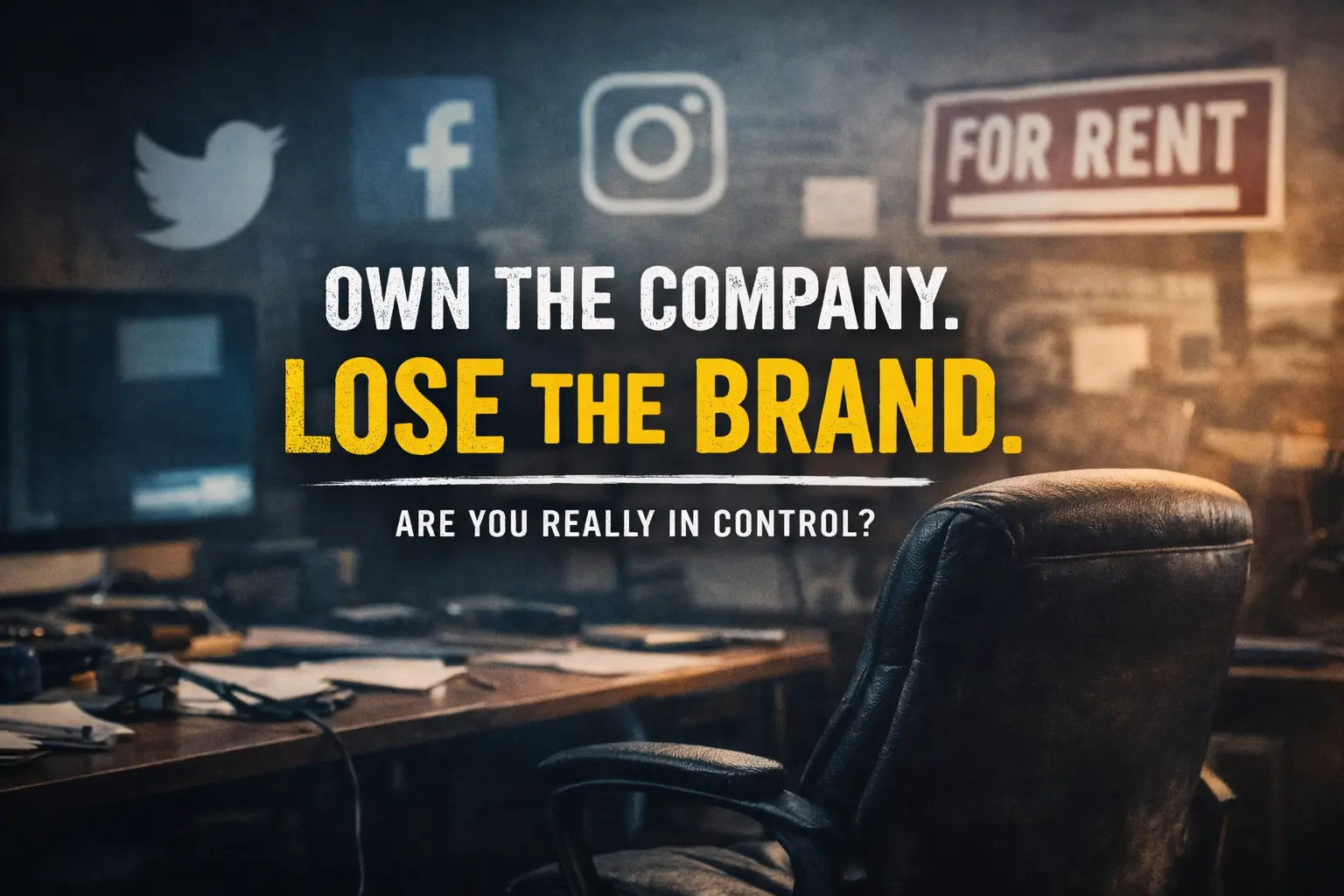
I’ve seen founders build impressive visibility on platforms they don’t control, only to discover later that visibility doesn’t move cleanly. Audiences don’t migrate. Attention doesn’t transfer. The brand existed there, not with them. This is one of the most common failures of brand ownership for founders, confusing rented attention with something they actually control.
That’s not a branding failure. It’s an ownership misunderstanding. Brand ownership for founders fails not in presentation, but in the underlying decisions they postpone or dilute.
The same thing shows up with names and domains, which people like to downplay because it sounds old-fashioned or superficial. It isn’t.
A compromised name doesn’t kill a startup. It just taxes it. This is where brand ownership for founders quietly erodes, not through failure, but through accumulated friction tied to names, domains, and recall. Slightly worse email response rates. Slightly longer sales cycles. Slightly more explanation in every conversation.
Again, nothing dramatic. Just drag.
Drag is dangerous because it feels like effort. Founders are used to effort. They think that’s normal.
“This is just how hard things are.”
Sometimes it is. Sometimes it’s self-inflicted.
I’ve spoken to founders who have spent years building around a name they don’t fully believe in, simply because changing it later felt scarier than living with it. That’s not strategy. That’s sunk cost talking. At that point, brand ownership for founders becomes less about choice and more about avoiding the discomfort of change.
What makes this worse is that the cost isn’t on a spreadsheet. It shows up socially. In perception. In trust. In how confidently other people talk about you when you’re not in the room.
You can’t fix that with better copy.
There’s also a deeper psychological piece founders don’t like admitting. Delaying brand decisions often isn’t about money or speed. It’s about identity.
Choosing a name, owning it fully, locking it in, is a form of commitment. It says, “This is what we are.” And that’s uncomfortable when you’re still evolving.
So founders keep things slightly provisional. Just in case.
The irony is that provisional brands rarely get treated seriously. Markets respond to confidence long before they respond to perfection.
Control isn’t about having everything figured out. It’s about being decisive enough that other people don’t have to guess.
When you really control your brand, introductions get shorter. Conversations move faster. You stop correcting people. You stop explaining.
You occupy a space instead of negotiating for it.
Most founders never reach that point because they confuse momentum with clarity. As long as things are moving, they assume nothing fundamental is wrong.
Then one day they want to raise, or sell, or partner, or expand into a more serious room, and suddenly all the small compromises line up at once.
The name feels weak.
The identity feels fragmented.
The brand feels louder than it should be, because it’s compensating.
That’s usually when founders start asking the questions they should have asked earlier.
Not “how do we market better?”
But “what exactly do we own?”
Brand Ownership for Founders Is Not the Same as Branding
This isn’t an argument for perfection. It’s an argument for intentionality.
Some compromises are rational. Some are lazy. The problem is most founders never separate the two.
Owning a company doesn’t automatically mean you control how it exists in the world. That control is built, decision by decision, usually earlier than people are comfortable with.
If there’s one test that cuts through the noise, it’s this:
If someone hears your name once, can they find you without friction?
If the answer isn’t a clean yes, there’s a control issue hiding somewhere. At its core, brand ownership for founders is about removing that friction before it compounds into strategy, trust, and valuation problems.
You don’t fix that with more content or louder messaging. You fix it by tightening the foundations you’ve been working around.
I spend a lot of time now on the buyer side of that equation, helping founders clean up these structural issues quietly, before they turn into public problems. Brand ownership for founders isn’t loud, visual, or performative. It’s structural, quiet, and felt most when it’s missing.
If this resonates, that’s exactly what buyeraxis.com exists for.
Not branding.
Not marketing.
Ownership.
Complimentary Risk & Valuation Assessment
Are you building equity or just renting space?
Most founders don’t realize their domain is suppressing their valuation until they sit down with an acquirer. Don’t let that happen to you.
I am offering a Complimentary Risk & Valuation Assessment for founders. I will review your current domain portfolio and analyze it against your target valuation goals.
In this audit, we will uncover:
• The Valuation Gap: How much is your current domain dragging down your multiple?
• The Traffic Leak Score: Is your current domain leaking traffic to competitors?
• The Upgrade Path: A strategic roadmap to acquire the asset that secures your legacy.
FAQ
What does it mean for a founder to truly control their brand?
It means people can find you, remember you, and refer to you without explanation. Control isn’t activity or visibility. It’s clarity and ownership.
Why do most founders lose control of their brand early?
Because they treat naming and identity as temporary decisions. They optimize for speed and flexibility, then spend years managing the consequences.
Is branding the same as brand ownership?
No. Branding is presentation. Ownership is infrastructure. You can have good branding and still not own how your company exists in the world.
How do domain names affect brand control?
A weak or compromised domain adds friction everywhere: email trust, referrals, search, and introductions. It doesn’t kill growth. It quietly taxes it.
Can a founder fix brand control issues later?
Yes, but later is always more expensive. The longer a brand operates with workarounds, the harder it becomes to correct without disruption.
How can founders test whether they really control their brand?
Simple test: if someone hears your name once, can they find you without guessing? If not, control is missing somewhere.
Is this a marketing problem or a structural problem?
Structural. Marketing amplifies what exists. It can’t fix unclear ownership or weak foundations.





2 Comments
Comments are closed.