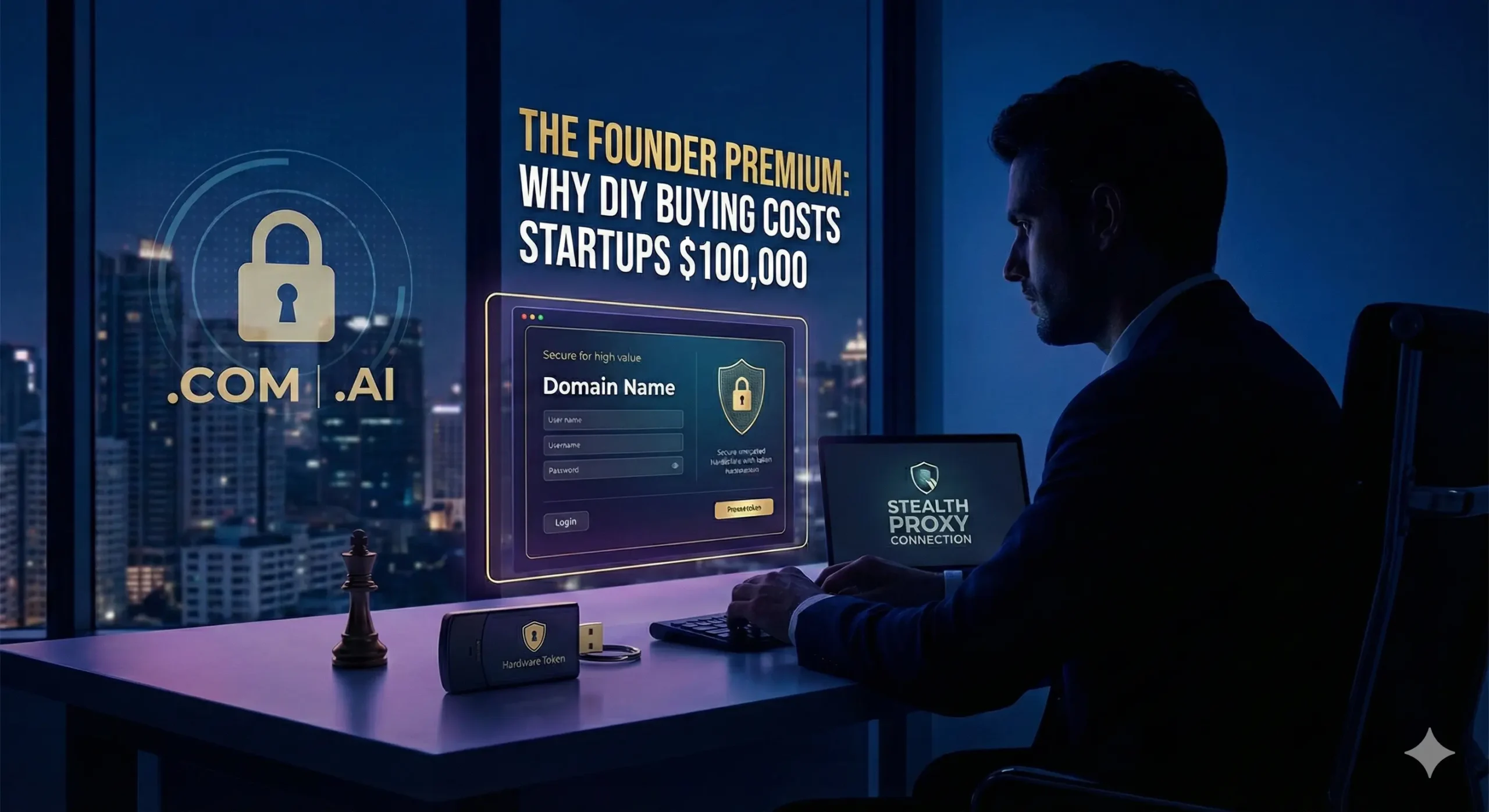
The Founder Premium: Why DIY Buying Costs Startups $100,000 Stealth Domain Acquisition Tactics
Key Takeaways for Founders:
The “Founder Premium” Penalty: Reaching out from a corporate email signals your funding status and desperation, causing professional sellers to inflate the domain’s asking price based on your valuation rather than the asset’s market value.
The Necessity of Stealth Domain Acquisition: The only way to secure a domain at fair market value is through anonymous, buyer-side representation, utilizing proxy infrastructure (like parked domains) to disguise the end-buyer’s identity.
The Danger of “DIY Stealth”: When corporate IT teams or founders attempt anonymous outreach themselves, they almost always leave a technical footprint (IP blocks, DNS history) or a behavioral “tell” (corporate jargon) that instantly exposes their identity to veteran domainers.
Zero-Risk Escrow Closing: Transactions must be executed through regulated, third-party escrow systems. The buyer funds the secure account, and the seller is only paid after the domain has safely landed in the buyer’s corporate registrar and full technical control is confirmed.
BLUF: When founders use their corporate email or LinkedIn to buy a domain, sellers instantly inflate the price based on the startup’s valuation—a penalty known as the “Founder Premium.” The only way to secure premium digital real estate at fair market value is through stealth domain acquisition, using anonymous infrastructure to negotiate strictly on the asset’s worth.
There is a specific moment in every successful startup’s journey where the “temporary” domain name becomes a liability. You’ve raised capital, your product is scaling, and you need the definitive, exact-match .com before a major public launch.
So, what do most founders do? They look up the WHOIS record, send a polite email from their corporate account, and introduce themselves.
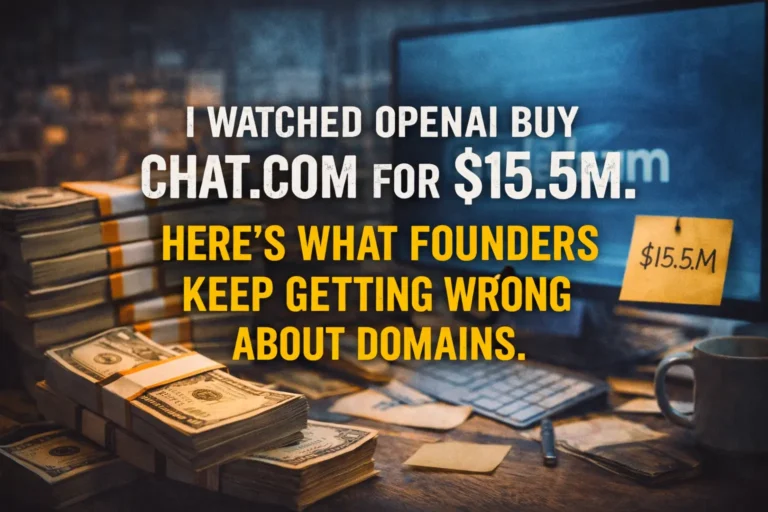
That single email usually costs them an extra $100,000.
In my 20+ years navigating digital assets and internet businesses, I have watched brilliant operators make this exact mistake. They treat buying a premium domain like buying software. But premium domains are not products; they are highly illiquid, unregulated, and fiercely protected digital real estate.
Table of Contents
The Mechanics of the “Founder Premium”
Domain sellers are not naive. When an owner receives an inquiry for a premium domain asset, the very first thing they do is investigate the buyer.
If you reach out directly, you hand them a loaded weapon. They will check your Crunchbase profile to see your recent Series A funding. They will look at your LinkedIn to gauge your company’s growth trajectory. They will assess how desperate you are to drop your .IO or .AI extension.
The moment your identity is revealed, the negotiation permanently shifts. The asking price is no longer based on the fair market value of the domain name. The price is now based entirely on your ability to pay and the strategic pain you will suffer if you don’t get it. This is the Founder Premium. Once you reveal your intent, you lose the ultimate leverage in any high-stakes negotiation: the credible ability to walk away.
The Counter-Intelligence Play: Stealth Domain Acquisition
To bypass the Founder Premium, you must remove your identity, your funding, and your brand from the equation. The negotiation must be strictly about the asset. This requires stealth domain acquisition—a specialized, investor-led approach to securing digital real estate anonymously.
At BuyerAxis, the entire methodology is built around counter-intelligence. We do not just send emails; we build an invisible perimeter around your brand.
Here is how a stealth operation is executed:
1. The Proxy Infrastructure
You cannot use a Gmail account, and you certainly cannot use your corporate domain. When connecting with domain sellers, it is a strategic necessity to use a parked, non-branded domain for the initial outreach. For example, initiating contact from an address like [email protected] signals to the seller that they are dealing with a fellow investor or a portfolio manager, rather than a venture-backed founder. This keeps the initial valuation grounded in reality.
2. Cycle-Aware Valuation
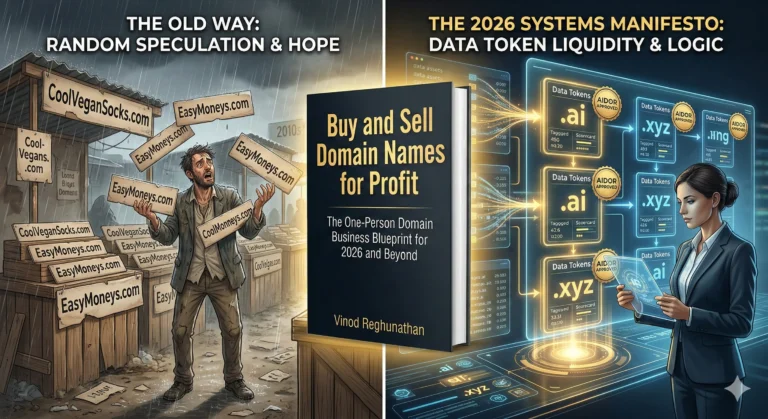
Before any contact is made, we utilize intelligence to determine the seller’s actual floor price. We analyze historical domain sales, previous drop records, and the seller’s current portfolio liquidity. By applying the valuation frameworks detailed in Buy and Sell Domain Names for Profit, we establish a hard data baseline to counter the inevitable “pie in the sky” asking price.
3. De-Identified Negotiation
The seller communicates entirely with a buyer-side representative. They do not know what industry the final buyer is in, what product they are launching, or how much capital they have raised. We absorb the emotional friction and use strict, data-driven counteroffers to grind the price down to fair market value.
The Danger of “DIY Stealth”
Understanding the stealth approach is easy; executing it without leaving a footprint is incredibly difficult.
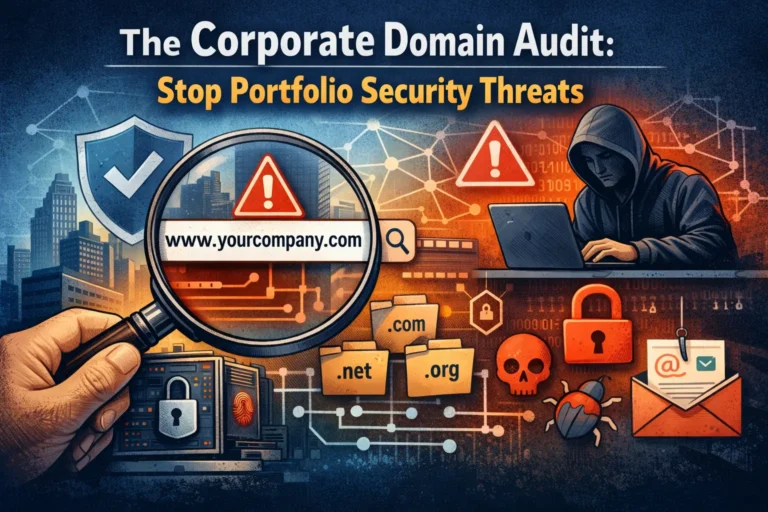
When corporate IT teams or founders attempt to set up their own proxy domains, they almost always leave a digital trail. They might register the parked domain using the company’s IP block, share corporate name servers, or accidentally link the proxy domain’s WHOIS data to the parent company’s registrar account.
Professional domain investors use reverse-WHOIS tools and historical DNS tracking. If your IT team leaves a single technical footprint, the seller will spot the corporate connection in 60 seconds.
Furthermore, amateur negotiators have a “tell.” A corporate lawyer or founder pretending to be an investor doesn’t speak the language. They use corporate jargon, ask for W-9s too early, or agree to escrow terms without understanding the transfer mechanics. The seller instantly realizes they are dealing with a disguised corporation, and the Founder Premium applies immediately. Even worse, without historical market data, the corporate buyer has no idea if the “discounted” price they negotiated is actually just a massive overpayment.
The Escrow Transition & Secure Closing
Once the final price is locked by our proxy, the transaction moves into a strictly regulated, third-party escrow environment. This is where anonymity meets absolute financial security.
We structure the transaction through an accredited escrow payment system. You, the buyer, fund the secure account directly. The seller then reviews and legally agrees to the terms of the transfer. We oversee the entire technical migration, ensuring the asset is safely moved.
The most important rule of this process: The seller is only paid after the domain has safely landed in your company’s registrar account and you have full, undisputed technical control.
Stop Negotiating Against Yourself
A premium domain is a permanent business asset that creates long-term leverage. But acquiring one requires discipline, patience, and absolute operational security—from the first anonymous email to the final escrow release.
If a domain materially impacts your brand, trust, or revenue, do not attempt to buy it yourself. Secure the asset, protect your capital, and eliminate the transfer risk.
[ Request a Confidential Domain Acquisition Consultation with BuyerAxis ]
FAQ
What is the “Founder Premium” in domain buying?
The Founder Premium is the inflated price a domain seller charges when they discover the buyer is a successfully funded startup, a wealthy founder, or an established enterprise. The price becomes based on the buyer’s capital rather than the domain’s actual market value.
What is stealth domain acquisition?
Stealth domain acquisition is the process of buying a high-value domain name anonymously. It utilizes proxy emails, parked domains, NDAs, and buyer-side brokers to negotiate the purchase without ever revealing the true identity or budget of the end buyer.
Why is it dangerous to contact a domain owner directly?
Contacting a domain owner directly reveals your intent and identity. Sellers will research your company’s funding and revenue, immediately inflating the asking price. It also creates emotional friction and eliminates your leverage to walk away from the deal.
How do you securely transfer a domain bought anonymously?
Anonymous domain transfers are finalized through secure, third-party escrow systems. Once the price is negotiated by the proxy, the buyer funds a regulated escrow account. The seller agrees to the transfer terms and initiates the domain transfer. The escrow service only releases the funds to the seller after the buyer has confirmed full technical control of the asset in their corporate registrar account.